


Spice and Powder Co-Packing: The Specialist’s Guide to Dry Food Manufacturing

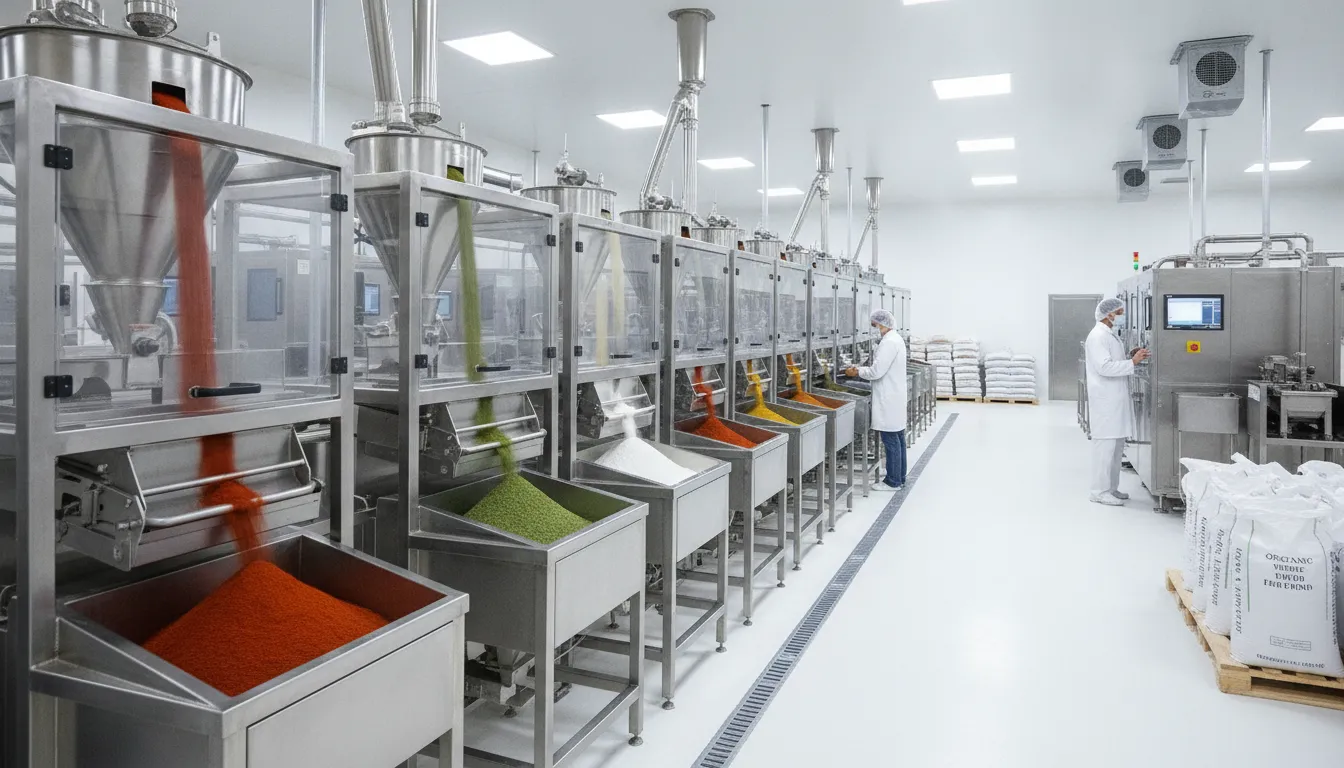
Mixing dry spice batches by hand limits how much you can make. As retail orders grow, the dust and slow work of dry packing blocks your growth. Switching to a professional co-packing partner removes those limits and lets you scale without owning production equipment.
Schedule Your Free Co-Packing Consultation Today
Spice and powder co-packing is a contract manufacturing service where a specialized facility blends. Fills, packages, and ships dry spice blends, seasoning mixes, and food powders for growing brands. Co Packing Express operates at 5,000+ units per hour with low minimums of 400 pounds for dry products. Making it an ideal partner for brands that have outgrown kitchen-scale production but are not ready for the massive minimums required by national operators. This guide covers the process, compliance, costs, and evaluation criteria spice brand owners need for an informed co-packing decision.
Co Packing Express brings together dry blending, automated filling, private labeling, warehousing, and FBA/FBM compliance under one roof. By partnering with a single provider for the full product lifecycle, brands simplify their supply chain and reduce the risk of coordination failures between multiple vendors. Below we break down every aspect of the service so you can evaluate whether spice and powder co-packing is the right next step for your brand.
What Is Spice and Powder Co-Packing?
Spice and powder co-packing is a dry food contract manufacturing service in which a specialized facility blends. Fills, packages, labels, and ships dry seasoning blends and food powders on behalf of your brand. Co Packing Express handles the entire production workflow from ingredient sourcing through final pallet delivery so you can focus on building your brand and landing retail accounts without investing in industrial equipment.
Spice and powder co-packing is a dry food production partnership where a contract manufacturer blends. Fills, packages, and ships custom spice blends and dry powders under your brand name. It allows growing food businesses to scale production without building their own FDA-compliant facility.
Many food brands start in home kitchens or shared commissary spaces, but they hit a ceiling as order volume grows. Buying high-speed dry packing lines, renting humidity-controlled warehouse space, and staffing a production shift costs hundreds of thousands of dollars upfront. A skilled dry co-packer removes that capital barrier by letting you pay per unit rather than per machine. Co Packing Express specializes in bridging this exact gap for the missing middle of spice brands that need professional production without industrial minimums.
Core dry blending and packaging services
Dry co-packing differs from liquid co-packing in every dimension of the production line. While liquid facilities use pumps, kettles, and fillers designed for sauces and beverages, dry plants rely on ribbon blenders, V-blenders, and auger fillers calibrated for powders. Co Packing Express operates dedicated dry blending lines that handle the following core services:
- Dry blending: Large-scale ribbon and paddle blenders that produce uniform spice mixes with consistent particle distribution across every batch.
- Automated filling: High-speed auger and volumetric fillers that dispense precise weights into pouches, jars, shakers, and bulk bags at rates exceeding 5,000 units per hour.
- Final packaging and labeling: Airtight sealing with induction liners or foil seals, followed by label application and case packing for retail or e-commerce fulfillment.
- QA sieve testing: Every batch passes through sieve analysis to verify particle size uniformity and remove oversize agglomerates before filling begins.
These co-packing services for dry goods are built for speed and precision. The blenders use timed mixing cycles validated by in-process moisture and particle-size testing so that every jar that leaves the line tastes identical to the first.
The missing middle niche
Many national dry co-packers require minimum runs of 10,000 pounds or more per SKU. This creates a gap for brands that have proven product-market fit in farmers markets or online stores but cannot commit to that volume. Co Packing Express fills that gap with a minimum of just 400 pounds of dry product or 100 gallons for liquids. As a dedicated spices and powders manufacturing partner, Co Packing Express works with brands testing new SKUs, launching seasonal blends, or scaling existing lines without overcommitting inventory. This flexibility lets brands validate new flavors on commercial equipment before placing large repeat orders. For example, a barbecue seasoning brand that sells 300 pounds monthly can place an initial 400-pound run. Validate the product fills at retail quality, and reorder in 400-pound increments as demand grows rather than committing to 5,000 pounds upfront. This pay-as-you-grow model is what makes professional co-packing accessible to brands at the missing middle stage.
Simplifying your supply chain
A full-service co-packer does more than blend and fill. Co Packing Express offers warehousing and order fulfillment from the same facility, so your inventory ships directly to retailers or Amazon centers. For Amazon sellers, Co Packing Express also handles FBA and FBM compliance requirements, including prepping and labeling shipments to meet Amazon’s inbound specifications.
The Dry Manufacturing Process: From Raw Ingredients to Finished Product
Dry spice manufacturing follows a five-stage pipeline: ingredient inspection, precision blending, sieve testing, automated filling, and final packaging. Each stage includes dedicated quality checks to ensure consistency, safety, and compliance from the first unit to the last.
Dry food production follows a five-stage pipeline. Co Packing Express documents each stage with standard operating procedures, and every batch carries a unique lot number that traces back to raw ingredient receipts.
Raw material sourcing and quality checks
Every production run begins with sourcing high-quality raw ingredients from vetted suppliers. When raw goods arrive at the facility, the quality team inspects each lot for purity, color, moisture content, and foreign material before anything moves to the blending floor. Ingredients that fail inspection are rejected before reaching production equipment.
Moisture control is one of the most critical dry food safety parameters. Excess moisture during storage can cause clumping, mold growth, and degradation of volatile spice oils that carry flavor and aroma. The Co Packing Express facility maintains climate-controlled dry storage with continuous humidity monitoring to keep raw ingredients within specified moisture ranges. This is critical for hygroscopic powders like onion powder and dehydrated flakes.
Step-by-step production pipeline
Step-by-step production pipeline. Transforming raw spices into a retail-ready product follows a documented sequence designed to maximize consistency and throughput while maintaining GMP compliance:
- Ingredient inspection: Quality teams weigh and inspect each raw ingredient against the batch record. Ingredients are screened for foreign particles, color uniformity, and moisture content. Only approved lots move to the blending stage.
- Precision blending: Ingredients are loaded into a ribbon or paddle blender in a sequence specified by the formula. Co Packing Express uses timed mixing cycles validated during the test batch phase to ensure complete particle distribution. Blending time, order of addition, and speed are recorded in the batch log.
- Sieve testing: After blending, technicians run a powder sample through a graduated sieve stack to verify particle size distribution. Any oversized agglomerates trigger a process adjustment before the batch proceeds to filling.
- Automated filling: Auger fillers dispense the blended powder into containers at target fill weights. In-line checkweighers verify every container and reject any that fall outside the specified tolerance range.
- Final packaging and palletizing: Containers are sealed, labeled with your branded artwork, coded with lot and expiration dates, and packed into master cases. Pallets are staged for shipment or on-site warehouse transfer.
Preventing segregation and clumping
Mixing dry powders is more complex than it appears because different spice particles have varying densities, shapes, and electrostatic properties. During transport and handling, smaller, denser particles can migrate downward while larger, lighter particles rise. This phenomenon, known as particle segregation, produces an inconsistent flavor profile from jar to jar. A customer who gets too much salt in one serving and too little in the next will not buy that product again.
Co Packing Express addresses segregation risk through validated blend times, controlled blender RPM, and particle size matching during formulation development. During the test batch phase, samples from the top, middle, and bottom of the blender are tested for compositional uniformity. This provides statistical confidence that the blend remains homogenous through the entire filling cycle. Sieve analysis before and after blending confirms that the particle size distribution meets your product specifications within plus or minus 5 percent of the target distribution for each mesh size. For products that are particularly prone to segregation, such as blends that combine fine ground spices with larger dried herb pieces. Co Packing Express can recommend processing adjustments including the addition of flow agents or modified blending sequences that keep the mix stable during packaging and transport.
FDA and GMP Compliance Standards for Dry Food Manufacturing
Dry spice manufacturing in the United States is regulated under FDA 21 CFR Part 117 (FSMA Preventive Controls for Human Food) and current Good Manufacturing Practices. These regulations govern facility sanitation, employee hygiene, equipment maintenance, allergen control, and batch traceability for every co-packing facility.
Compliance is not optional in food manufacturing. Every facility that produces, processes, packs, or holds food for human consumption in the United States must operate under the FDA’s Preventive Controls for Human Food rule. Co Packing Express maintains full FDA and GMP compliance across all production lines, and every batch is subject to documented preventive controls that are reviewed and updated annually. The facility operates under a written food safety plan that is overseen by a Preventive Controls Qualified Individual (PCQI) as required by the FSMA rule.
Good Manufacturing Practices for dry spices
Dry food safety requirements differ from wet or ambient production because dry powders present unique hazards. Fine spice dust can become airborne and settle on surfaces, creating cross-contact risks. Volatile oils in spices can degrade if exposed to heat or humidity. GMP compliance for dry facilities therefore includes HEPA filtration in processing zones, positive air pressure differentials, and strict humidity controls. Co Packing Express maintains these GMP standards following the FDA’s FSMA Preventive Controls framework, and the facility undergoes regular internal and third-party audits to verify ongoing compliance.
Preventive controls and hazard analysis
The Food Safety Modernization Act requires every food facility to conduct a hazard analysis that identifies biological, chemical, and physical risks specific to its products and processes. For dry spice manufacturing, common hazards include metal fragments from grinding equipment. Allergen cross-contact from shared production lines, and pathogen survival in low-moisture environments such as Salmonella in spice powders. Co Packing Express addresses these risks with metal detection at the filling stage, dedicated allergen sanitation protocols between runs, and moisture monitoring throughout the production cycle. Each batch’s quality control documentation records these preventive controls alongside the test results that verify they were effective.
Allergen control and traceability
Dry blends often contain major allergens including soy lecithin, milk powder, wheat starch, and mustard flour. When the same equipment produces multiple formulations, cross-contact prevention requires validated cleaning procedures between allergen-containing and allergen-free runs. Co Packing Express uses dedicated equipment for allergen-free lines where possible and follows documented allergen changeover protocols that include thorough cleaning. Visual inspection, and allergen swab testing before the next production run begins. For example, a production line that ran a chili powder blend containing mustard flour undergoes a full wet-clean cycle followed by a dry purge with an inert filler. Then swab samples are collected from six contact surface locations and tested using ELISA methods to confirm allergen protein levels are below detectable limits before a gluten-free seasoning run starts on the same line. This level of rigor is documented in the batch record and available for brand review.
Traceability is equally critical. In the event of a supplier recall or quality deviation, the brand must be able to identify every affected unit within hours. Co Packing Express assigns unique lot numbers at the ingredient receipt stage and tracks those lot numbers through blending, filling, and packaging. Detailed batch logs record: the unique lot numbers for every raw spice ingredient, the exact weights and blend times used during mixing. The cleaning logs and allergen swab results for the production line, and the moisture level and sieve test results for the completed batch. This paper trail meets FDA traceability requirements and gives brands full visibility into their production history.
How Much Does Spice and Powder Co-Packing Cost?
Spice and powder co-packing costs typically range from $2,500 to $3,000 for an initial test batch. With ongoing production pricing determined by batch size, packaging format, ingredient complexity, and run frequency. Co Packing Express provides transparent pricing with no hidden setup fees.
Understanding the cost structure helps you compare outsourcing versus in-house economics. Pricing follows three phases: formulation and testing, production scaling, and ongoing manufacturing.
Test batch and setup costs
Every new product line starts with a test batch that validates the recipe on commercial equipment. At Co Packing Express, a test batch costs $2,500 to $3,000. This investment includes nutritional analysis and basic label design guidance to help you meet FDA labeling requirements. The test batch lets you evaluate flavor consistency, packaging compatibility, and retail shelf appeal. Consulting services are available at $300 per hour for formulation guidance. Labels must comply with FDA food labeling regulations for nutrition panels, ingredient declarations, and allergen statements. Co Packing Express can review your label artwork for compliance before you print.
Production volume and unit costs
Once the recipe is validated, ongoing production costs depend primarily on batch size and packaging format. Smaller batches carry higher per-unit costs because setup, cleaning, and changeover time is spread across fewer units. As volume increases, the per-unit cost decreases. Co Packing Express helps brands scale gradually by starting at 400 pounds of dry product per run. As a reference point, a 100-gallon liquid batch in 12-ounce bottles runs approximately $7,000. Using co-packing services for dry goods avoids six-figure capital expenditures. Buying equipment and passing GMP audits can exceed $100,000 before producing a single unit.
Co Packing Express requires a 75% deposit upfront with 25% due upon completion. Deposits are non-refundable because materials are procured specifically for each production run. Production tolerances follow the industry-standard +/- 10% to account for normal variation in ingredient density and process conditions. Deviations outside this range require documented investigation before the batch is released for shipment.
In-house vs. outsourced production comparison
The financial case for co-packing becomes clear when you compare the full cost structure of building and operating a private facility versus partnering with an established manufacturer.
| Cost Factor | In-House Facility | Co Packing Express |
|---|---|---|
| Initial capital investment | Over $100,000 for equipment, HVAC, and GMP buildout | Minimal test batch fee. |
| Labor costs | Full production staff plus QA and sanitation team | Included in per-unit pricing. |
| Compliance burden | You manage FDA audits, HACCP plans, and preventive controls | Managed by Co Packing Express. |
| Production speed | Limited by equipment size and staffing | Up to 5,000+ units per hour |
| Packaging flexibility | Single format unless you buy multiple lines | Pouches, jars, shakers, bags, and bulk. |
| Supply chain management | Separate warehouse, logistics, and fulfillment vendors | Single provider from concept to distribution. |
Private Labeling and Product Development for Spice Brands
Private labeling through a spice co-packer lets you launch retail-ready products under your own brand name without building a production facility. Co Packing Express manages the full product development cycle from recipe formulation through nutritional labeling and commercial scale-up.
Launching a spice brand requires more than mixing ingredients. Co Packing Express offers comprehensive private labeling services that take your concept from formulation to store shelf, removing the burden of kitchen buildout and GMP certification.
Recipe R&D and spice sourcing
Creating a differentiated flavor profile is the first step in building a spice brand. Co Packing Express supports recipe development with experienced formulation guidance, sourcing high-quality raw spices from a network of trusted global suppliers.
Whether you have a fully developed formula that needs scale-up or a concept that needs a food scientist’s input. The team can work with you to create a production-ready blend. Testing runs are conducted at small scale first, then validated on commercial blending and filling equipment during the test batch phase.
This staged approach ensures your recipe translates predictably from kitchen bench to production line. During the R&D phase, the team can help adjust variables such as granulation size, flow characteristics, and moisture content to optimize the blend for high-speed filling equipment. A formula that works perfectly in a small bowl may behave differently in a 500-pound ribbon blender. Co Packing Express protects your proprietary formulations with NDA-backed confidentiality throughout the entire development process.
Formula security and facility safety
Your seasoning blend is your intellectual property and the foundation of your competitive advantage. Co Packing Express offers NDA protection for all proprietary formulas, ensuring that ingredient ratios and processing methods remain confidential throughout the partnership. All production occurs in FDA-compliant environments with GMP protocols for sanitation and environmental monitoring. Closed blending systems prevent cross-contact between runs. Co Packing Express also offers customers the option to review in-process quality documentation including temperature and humidity logs, sieve analysis reports, and finished product COAs for each batch. Co Packing Express also offers customers the option to review in-process quality documentation including temperature and humidity logs, sieve analysis reports, and finished product COAs for each batch.
Nutritional labeling and scale-up
Regulatory compliance for food labeling requires accurate nutritional panels, ingredient declarations in descending order by weight, allergen statements, and net weight statements that meet FDA format requirements. Co Packing Express provides guidance on FDA-compliant labeling rules to ensure your artwork passes regulatory review before you go to print. Once the recipe and label design are finalized, the scale-up process moves through three phases: test batch validation to confirm the formula works on production equipment. Initial production run to fill your first inventory, and repeat production runs with verified quality metrics.
How to Choose the Right Spice and Powder Co-Packer
Choosing a spice co-packer requires evaluating minimum order quantities, compliance credentials, communication systems, and supply chain capabilities. A thorough evaluation upfront prevents costly switching costs and production delays once your product is in market.
Not all co-packers are equal.
Minimum order quantities and business fit
Start by estimating your first-year sales volume across all channels. Compare that forecast to each co-packer’s minimum batch size. Large national operators typically require 10,000 pounds or more per run. Which ties up inventory capital and increases risk if a new SKU does not sell through as quickly as projected. Co Packing Express sets its dry co-packing minimums at 400 pounds, allowing brands to place smaller, more frequent orders that match actual demand. This reduces the financial risk of overproducing a new blend and frees up working capital for marketing and distribution.
Certifications and facility audits
Not all food facilities operate at the same compliance level. When evaluating a co-packer, ask for evidence of current GMP certifications, third-party audit results, and the facility’s most recent FDA inspection outcome. Co Packing Express maintains GMP compliance across all production lines and welcomes qualified brand representatives for facility tours. The facility operates under a documented FSMA-compliant food safety plan that includes hazard analysis, preventive controls, and a recall procedure. Brands should also verify that the co-packer’s allergen control program matches their product requirements. If your spice blend is labeled gluten-free or free-from a specific allergen, the facility must be able to demonstrate validated cleaning protocols for shared equipment. Finally, request proof of general liability insurance and product liability coverage. A reputable co-packer carries product liability insurance to protect both parties in the event of a product issue.
Communication and responsiveness
A co-packing relationship involves ongoing coordination on inventory levels, production scheduling, label updates, and quality documentation. Evaluate how each candidate handles communication before you sign a contract. Co Packing Express operates 24/7/365 production cycles and provides dedicated account management for active clients. Batch records, COAs, and production reports are available on request. Brands that prioritize responsive communication tend to have smoother scale-up experiences.
Supply chain integration
The most efficient co-packing partnerships integrate manufacturing, warehousing, and fulfillment into a single operation. Co Packing Express offers on-site warehousing and direct-to-consumer, wholesale, and Amazon fulfillment from the same facility that produces your product. This eliminates the need to transfer finished goods between separate warehouses and reduces the risk of damage or contamination during intermediate handling. Brands that sell through multiple channels benefit from the ability to ship wholesale pallets to distributors. Individual cases to retail buyers, and Amazon-bound shipments from a single inventory pool managed by one partner. For e-commerce brands, FBA and FBM prep services ensure Amazon inbound shipments meet platform requirements.
When Is Spice Co-Packing the Right Move for Your Brand?
Spice co-packing is the right choice when your brand consistently sells through inventory faster than your current production method can keep up. When product-market fit is proven and the main constraint is production capacity, or when you need GMP-compliant manufacturing to access retail and grocery channels.
Not every brand needs a co-packer immediately. Recognizing the right timing for the transition helps you avoid moving too early. When the per-unit cost premium outweighs the benefits, or too late, when stockouts damage retail relationships. Here are the specific indicators that it is time to engage a professional spice co-packing partner.
Signs you are ready for co-packing
Signs you are ready for co-packing. Several clear signals indicate that your brand has outgrown small-batch production and is ready for a commercial co-packing arrangement:
- You are consistently turning away wholesale orders because you cannot produce enough volume.
- You spend more time managing production logistics than marketing and sales.
- A major retailer or distributor has requested a meeting to discuss shelf placement, and you need GMP-compliant manufacturing to qualify.
- Your current production setup operates at or near full capacity with no room for growth.
- Amazon FBA stockouts are occurring regularly because your production cycle cannot keep pace with sell-through rates.
If three or more of these signals describe your current situation, it is time to begin evaluating co-packing partners. Co Packing Express works with brands at this exact inflection point, providing the production capacity and compliance infrastructure needed to take the next step. The typical timeline from consultation to first production run is 4 to 8 weeks. Brands should begin the evaluation process about two months before they expect to exceed capacity, ensuring a smooth transition.
When to keep production in-house
On the other side of the decision, there are scenarios where co-packing may not be the best fit yet. Brands that are still iterating on their core recipe, selling fewer than 400 pounds of dry product per month. Or operating primarily through local farmers markets may benefit from continuing small-batch production a while longer. Co-packing economics improve with volume, so a brand that is producing less than one minimum batch per quarter will pay a premium per unit. In those cases, we recommend continuing with your current setup until demand justifies the transition. When that point arrives, Co Packing Express will be ready to help you scale.
Frequently Asked Questions
What is the minimum order quantity for spice and powder co-packing?
Co Packing Express requires a minimum of 400 pounds for dry spice and powder products and 100 gallons for liquid products. This is significantly lower than the 10,000-pound minimums common among national co-packers, making it accessible for growing brands with proven product-market fit.
How much does a spice co-packing test batch cost?
A test batch at Co Packing Express costs $2,500 to $3,000, which includes nutritional analysis and label design guidance. This allows you to validate your recipe on commercial equipment before committing to full production runs.
What certifications does an FDA-compliant dry co-packer need?
A compliant dry spice co-packer operates under FDA 21 CFR Part 117 and current Good Manufacturing Practices. Co Packing Express maintains GMP compliance with regular internal and third-party audits.
Can I protect my proprietary spice blend formula?
Yes. Co Packing Express offers NDA-backed protection for proprietary formulations, ensuring your ingredient ratios and processing methods remain confidential. This legal protection covers all stages from recipe development through commercial production.
What is the difference between spice and powder co-packing and liquid co-packing?
Dry co-packing uses ribbon blenders and auger fillers designed for powders, while liquid co-packing uses kettles and pumps for sauces and beverages. Each requires different equipment, sanitation protocols, and compliance considerations, which is why Co Packing Express operates dedicated dry blending and filling lines.
Ready To Scale Your Dry Food Brand With a Professional Co-Packer?
You have read through the process, the compliance requirements, the cost structure, and the evaluation criteria. The next step is a conversation. Co Packing Express works with spice and powder brands at every stage of their growth journey, from first test batch through full-scale national distribution. Our team can review your product requirements, provide a detailed quote for your specific formulation and packaging needs, and answer any questions you have about the production process.
Schedule Your Free Consultation
Or call us at (469) 978-3889 to speak directly with our production team about your spice and powder co-packing project.