


Co-Packing for Amazon FBA Sellers: The Complete Guide

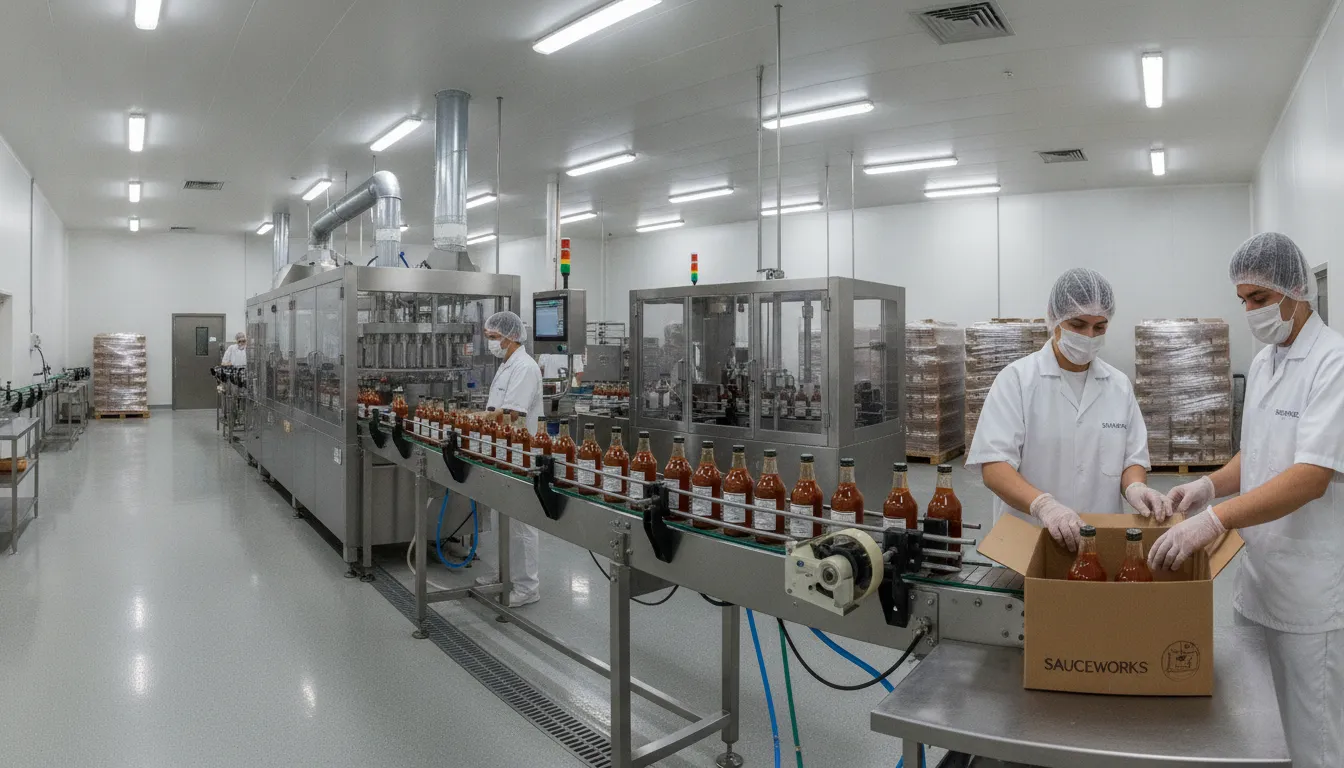
Running out of food inventory on Amazon can kill your search ranking in hours. For growing brands, home kitchens cannot match the fast sales of the e-commerce marketplace. Successful food sellers need a real factory partner to keep their products in stock.
Co-packing for Amazon FBA sellers is a special contract manufacturing service that produces, packages, and prepares food products to meet strict online marketplace standards. This service helps growing food brands scale by moving production out of small home kitchens and into expert, FDA-compliant facilities. A quality contract partner handles everything from recipe scaling and ingredient sourcing to final custom packaging and barcode prep. This all-in-one approach allows online sellers to avoid costly stockouts, maintain high quality, and satisfy Amazon’s strict shipping rules without buying expensive factory equipment. Ultimately, combining professional food production with direct-to-warehouse logistics under one roof allows e-commerce brands to grow their sales safely while protecting their listing rankings.
To scale successfully, sellers must understand how to navigate this manufacturing and packaging landscape. If you want to expand your inventory, you might wonder about the exact role of a contract partner. To help you succeed, we will start by looking at What Is Co-Packing for Amazon FBA Sellers? The path begins with
What Is Co-Packing for Amazon FBA Sellers?
Selling food on Amazon requires a fast and reliable supply chain. For many brands, co-packing for amazon fba sellers is the key to scaling without buying a factory. Co-packing is when a trusted producer makes, packs, and prepares your food products for you. It lets you outsource the hard work of production so you can focus on marketing and growth.
The Bridge from Kitchen to Factory
Many brands start out making their products in home kitchens or local incubators. But once sales grow, these small spaces cannot keep up. Professional co-packing and contract manufacturing services bridge the gap between small-batch artisanal production and high-volume industrial manufacturing. This lets your business grow from a local startup into a national brand.
Working with a partner means you do not need to buy expensive machines. You also do not need to lease warehouse space or hire a large crew. Instead, you pay a partner to handle these tasks for you. This saves your brand money and lets you launch new products much faster.
All Services Under One Roof
The best co-packing partners do not just mix your ingredients. They provide an integrated solution that covers the entire product lifecycle. This includes product development, manufacturing, packaging, quality control, warehousing, and logistics under one roof. For a brand owner, having one partner handle every step reduces mistakes and saves time.
This all-in-one setup is helpful for online sellers. You do not have to ship bulk goods from a kitchen to a separate packing facility, and then to a prep center. The same team that makes your product can pack it to meet strict warehouse standards. This keeps your supply chain simple and lowers your shipping costs.
FBA Prep and Legal Compliance
Amazon has strict rules for how food products must arrive at their warehouses. If your shipments do not meet these standards, you may face fines or product rejections. A professional partner ensures your items are fully prepped and labeled. They must also follow strict federal laws.
Under federal rules, the FDA does not pre-approve labels before they hit the market. Instead, they hold the producer responsible for making sure all labels are accurate. At Co-Packing Express, we make sure your brand is both compliant and agile. We offer low minimum order quantities of 100 gallons for liquid products or 400 pounds for dry blends. Our team works with 24/7/365 production flexibility to meet your tight deadlines. We also follow full FDA 21 CFR Part 117 and GMP guidelines to keep your food products safe and high-quality.
Why Amazon Sellers Need Co-Packing Partners in 2026
Amazon brands that make between 1 million and 10 million dollars in sales must have steady production. Without it, they face stockouts that hurt their search ranks and sales. In 2026, the site made major changes to how products must be packed and sent to warehouses. To stay ahead, smart brands now rely on co-packing and contract manufacturing services to manage their stock.
The end of Amazon prep services
On January 1, 2026, Amazon ended all of its FBA prep and label services in the US. In the past, sellers could pay Amazon to label bags, apply barcodes, or wrap fragile glass. Now, those options do not exist. If you sell food or drinks on the platform, your products must arrive at the warehouse fully prepared. This major shift makes FBA/FBM compliant fulfillment a vital part of your supply chain.
Sellers can no longer rely on Amazon to fix mistakes. If a shipment lacks the right labels, Amazon will not fix it for you. Instead, they will flag the shipment as a defect and charge a steep fee. This is why expert co-packing for amazon fba sellers has become so important. An expert partner ensures that every single box and bottle meets strict store guidelines before it leaves the factory floor.
Inbound defect fees and error costs
The cost of shipping errors has grown very fast this year. Inbound defect fees are now up to 80x higher than before. These fees range from $0.32 to $5.72 per unit. If you send a small batch of 500 units with the wrong barcodes, you will face an instant fine of $870. These high costs can quickly ruin your profit margins on a top product line.
Bulky items face even larger costs if they lack the proper packaging. The Ships in Product’s Own Packaging, or SIPP, rules now create a big price gap. If your bulk food boxes are not SIPP certified, you will pay a fee of over four dollars per unit. An expert co-packer knows how to pack your dry or liquid goods to pass SIPP tests and keep your costs low.
Federal packaging and label rules
Selling food on Amazon requires you to follow strict laws. Both the Federal Food, Drug, and Cosmetic Act and the Fair Packaging and Labeling Act govern your items. Under federal rules, the FDA does not pre-approve food labels before they hit the market. Instead, the agency holds you and your manufacturer fully responsible for ensuring that all labels are correct. A single mistake can lead to a listing ban or federal fines.
Working with an FDA-compliant co-packer is the best way to protect your business. They have the skills to make sure your labels meet both FDA standards and FBA requirements. From precise allergen warnings to exact barcode placement, they handle the complex details of food safety. This leaves you free to focus on growing your brand and scaling your e-commerce sales.
The Co-Packing Process: From Recipe to FBA-Ready Product
Scaling a food brand can feel like a major challenge. Many sellers start in small home spaces but soon find they cannot keep up with orders. Working with a partner who can manage your whole supply chain solves this problem.
The path to retail readiness
A full co-packing partner handles everything you need under one roof. This complete service lets you focus on growing your store while we handle the hard manual work. We manage the full product path, which includes product development, strict quality checks, warehousing, and shipping. This one-stop approach cuts down on your shipping costs and saves you time.
For many brands, finding a setup that fits their size is hard. Large plants often demand huge runs of one hundred thousand units or more.
This is why low minimums are so helpful for new and growing stores. You do not need to spend all your cash on a massive first run. This lets you launch with a smaller batch to test the market.
Six key steps to market
Our method is simple and clear. We work with you at every stage. This ensures your goods are safe, high in quality, and ready for retail shelves.
- Consultation and NDA. We start with a talk about your brand goals and food concept. To keep your ideas safe, we sign a non-disclosure agreement before you share any details about your formula.
- Formulation and test batch. We adapt your custom formula for large production runs. A test batch costs $2,500 to $3,000. This lets you check the taste and texture before full production.
- Commercial production run. Once you approve the sample, we start the first full run. Our low minimums of 100 gallons for liquids and 400 pounds for dry products help you scale without big financial risks.
- Packaging and labeling. We pack your products into final jars, bottles, or pouches. The FDA does not pre-approve food labels. Instead, it holds makers responsible for following the Fair Packaging and Labeling Act.
- Amazon FBA preparation. Our team prepares your shipments for Amazon warehouses, making sure every box meets strict rules. This ensures you get FBA/FBM compliant fulfillment without costly seller fees or delays.
- Warehousing and shipping. We store your goods in our clean space and ship them out as orders come in. Having a single point of contact for both production and shipping means you do not have to work with multiple firms.
Why low minimum order quantities matter
High entry barriers often stop good brands from growing. Most contract makers do not want to talk to you unless you order massive lots. Our low minimum order quantities change this system by letting you test new flavors and grow at your own speed.
Our St. Petersburg plant can run at high speeds when your brand is ready to scale. Our plant can fill 5,500 units per hour for liquid goods. This high output means we can easily meet sudden spikes in demand without any stockouts. Your brand can stay on Amazon shelves even during busy shopping seasons.
Using co-packing for amazon fba sellers gives you the tools to compete with large firms. You get the quality of a big brand with the quick speed of a small startup. This keeps your business lean and ready for growth.
Private Label Food Manufacturing vs. Co-Packing: What Is the Difference?
When you look for co-packing for amazon fba sellers, knowing how it compares to private labeling is vital. You can build your brand through private label food manufacturing, or you can use a co-packer. Both paths help you scale your business, but they work in their own ways. Knowing how they differ helps you pick the best model for your brand.
Ownership of the recipe
The main difference between these two routes is who owns the food formula. In co-packing, you provide the unique recipe, and the maker blends and packages it. In contrast, private label food manufacturing lets you choose a pre-made recipe owned by the maker. You then sell this proven product under your own brand name.
Each path has its own pros for your brand. If you have a secret family recipe or a custom formula, you must use a co-packer to make it. If you want to sell a standard item like hot sauce or spices, private label is a faster path. In both cases, you need a partner who knows how to run a clean, safe plant.
Production and brand control
Your choice also affects your level of production control and your startup costs. Co-packing gives you full control over your recipe, but you must invest more time and money to make the product. Private labeling has lower upfront costs because the recipe is already set. This makes it a great choice for quick market entry. Co-Packing Express offers both options under one roof in St. Petersburg, FL.
Both options need you to follow strict packaging rules. The FDA does not pre-approve labels before they hit the market, but they hold you liable for any errors. Launching a brand through private labeling for e-commerce brands is a multi-stage process from design to launch. Choosing a pre-made formula speeds up this work because the recipe is already safe and stable.
Selecting the right approach
Choosing between these models depends on your budget and your timeline. If you want to test the market quickly, private label is often the best choice. If you want to build a truly unique brand with a custom taste, co-packing is the way to go. No matter which route you choose, you need a partner that understands the needs of online stores.
A good partner can help you manage these stages. At Co-Packing Express, we help Amazon sellers with both paths. We can blend your custom recipe or help you select a proven private label formula to launch your brand. This lets you focus on marketing while we handle the complex manufacturing details.
The table below shows a clear breakdown of how these two options compare. You can see how recipe ownership, costs, and setup times differ between the models. Use this table to decide which path fits your current business goals.
| Feature | Private Label | Co-Packing |
|---|---|---|
| Recipe Ownership | Manufacturer owns the formula | You own the formula |
| Upfront Cost | Lower development cost | Higher development cost |
| Time to Market | Fast launch | Slower launch |
| Product Customization | Limited to pre-made options | Fully customizable |
Understanding Co-Packing Costs and Minimums for FBA Sellers
Finding the right co-packing and contract manufacturing services is a vital step for growing food brands. Choosing the right co-packing for amazon fba sellers starts with a clear view of costs and minimums.
Minimum Order Quantities for Liquid and Dry Foods
Many big factories demand huge production runs that small brands cannot afford. We help you scale by keeping our minimum order quantities low. This approach makes professional co-packing easy for startups to use.
For liquid foods like sauces and syrups, the minimum run is 100 gallons. For dry foods like spice blends and protein powders, the minimum run is 400 pounds.
These low limits let you test new items without taking big risks. Our low minimums help you lower your upfront product development costs so you can launch and manage your cash flow.
A Clear Breakdown of Production Fees
Launching a food product needs careful prep and expert support. Our consulting service costs $300 per hour to guide you through your first setup. This service covers formula reviews and kitchen planning.
Before a full run, you must buy a test batch for $2,500 to $3,000. This test batch is vital for quality control and FDA safety. It includes your nutrition facts panel, label design, physical labels, and process approval.
Process approval is a key step because the FDA does not pre-approve food labels, but it holds makers responsible for ensuring labels are correct. Our team guides you through these labeling rules to keep your brand compliant.
To help you plan, let’s look at a typical production run. A batch of 100 gallons of BBQ sauce in 12-ounce bottles costs about $7,000. This allows you to launch your product with professional packaging.
This price includes blending, bottling, sealing, labeling, and getting your product retail-ready. This example shows how low minimums make it easy to start a private brand. You can focus on marketing while we handle the heavy lifting.
Deposits, Tolerances, and Seasonal Consistency
Our payment structure is simple and designed for long-term growth. We ask for a 75% non-refundable deposit upfront, which we apply directly to raw materials. This deposit secures your production slot and materials.
The remaining 25% balance is due upon completion of your production run. In contract manufacturing, a standard production tolerance is plus or minus 10% of the target yield. This tolerance is normal across the food industry.
This variance means your final unit count may be slightly higher or lower than the initial estimate. We charge you only for the actual units we pack, which keeps your costs fair.
Also, our pricing does not change based on the season or the time of year. You get the same fair rates in summer and winter, which helps you project your margins with confidence. This stable pricing is vital for Amazon sellers who must maintain stable list prices on the marketplace.
Compliance and Regulatory Requirements for Amazon Food Sellers
Selling food on Amazon comes with strict legal duties. To keep your brand safe, you must follow federal laws. Expert co-packing for amazon fba sellers can help you meet these rules. The Federal Food, Drug, and Cosmetic Act and the Fair Packaging and Labeling Act govern these products. If you fail to follow these laws, you risk swift fines and store bans.
Federal food laws and packaging rules
You need to know that the FDA does not pre-approve food labels. But the agency holds you and your partner liable for any label errors. If your packaging is wrong, Amazon will stop your sales. Working with a compliant partner keeps your brand safe. They make sure your labels meet all federal laws before your goods ship.
You must meet nutritional panel rules. If you sell acid foods, you must also file a scheduled process. The FDA has strict rules for how you list calories, fats, and daily values. A skilled co-packer can guide you through these filings and help draft compliant panels. This prevents costly delays.
A top co-packer works under FDA 21 CFR Part 117 rules. These rules require strict current Good Manufacturing Practices. A clean plant stops germs. This keeps your product pure and ready for the market. It also saves you from high Amazon defect fees.
Allergen control and clear labeling
Allergen control is a major focus for federal food agents. According to the FDA, eight major food groups cause ninety percent of food allergies in the U.S. These groups include milk, eggs, fish, wheat, and soy. If your food contains these items, your label must state it clearly. A single allergen error can lead to a costly recall.
To protect buyers, a co-packer uses strict plans to isolate allergens. They clean the lines deep between production runs. They also store raw goods in different areas. This stops cross-contact and keeps your brand compliant with Amazon rules. Doing this by hand in a home kitchen is too hard as you grow.
Amazon logistics and food grade storage
Meeting Amazon rules does not end when your product is made. FBA prep and labeling are strict. If your boxes are not packed right, Amazon may reject your shipment. Working with an FBA/FBM compliant co-packer ensures that your goods are boxed and labeled to exact platform rules.
Your food items must also sit in a safe, clean space before they ship. Meeting food-grade warehousing requirements is vital for safety. Safe storage stops spoilage, pests, and mold from ruining your stock. A partner who handles both production and warehousing keeps your supply chain simple. This helps you scale your store fast without risking product quality or seller standing.
How to Choose the Right Co-Packing Partner for Your FBA Brand
To scale an online store, you must find a partner that matches your supply chain. Finding a team that does co-packing for amazon fba sellers means you must check both batch sizes and shipping. A good co-packer helps bridge the gap between small-batch artisanal production and high-volume industrial manufacturing. The right choice keeps your shop stocked while keeping your costs low.
Minimum order and capacity
Some large co-packers use automated packaging machines for dry food products. But their minimum order rules are far too high for growing brands. For example, Econo-Pak offers vast capacity but targets very large brands. On the other side, MyFBAPrep handles e-commerce prep but does not do food manufacturing under one roof.
For food brands, you need a partner with low minimums. You should look for limits like 100 gallons for liquids or 400 pounds for dry blends. Our site can pack 5,500 units per hour for liquid products. This high speed helps Amazon FBA/FBM sellers with $1M-$10M in revenue get reliable production to avoid stockouts.
Compliance and scheduling speed
Food safety is a critical part of your business. The Federal Food, Drug, and Cosmetic Act governs all food items in the United States. While federal rules say food makers must make accurate labels, the FDA does not pre-approve food labels before they hit the market. This is why you must work with a team that has strict food safety compliance built into their daily work.
Your partner must also follow Good Manufacturing Practices (GMPs) under FDA rules. These standards prevent food spoiling and keep quality high. Working with a safe team reduces the risk of bad batches and customer complaints.
Production speed is just as vital. Many co-packers use rigid calendars that can delay your next run by months. A flexible partner that works 24/7/365, including weekends and holidays, keeps your inventory fresh. This speed lets you react quickly to sudden spikes in sales.
Integrated shipping and logistics
When you buy co-packing services, look for a team that handles both making and shipping. Bulk transit adds shipping costs and risks. To protect your goods, your partner must meet food-grade warehousing requirements.
An integrated partner manages production, quality tests, and fulfillment services for food products under one roof. Choosing a partner in a key shipping hub, like our St. Petersburg facility, lets you store and ship products nationwide.
Shipping from St. Petersburg, Florida offers a strong shipping advantage for the Southeast market. You can reach millions of customers in days while saving on freight fees. This allows you to manage your stock well and maintain high margins on Amazon.
Frequently Asked Questions
How much does co-packing for Amazon FBA sellers cost?
Pricing starts with a fee of $300 per hour for consulting services. A test batch ranges from $2,500 to $3,000 to prove your recipe at scale. Production runs need a 75% non-refundable deposit before work begins, with the final 25% due upon completion. To plan your budget, read our guide on product development costs.
What are the minimum order quantities for food contract manufacturing?
Minimum order quantities depend on the product type. For liquid goods like sauces and marinades, the minimum is 100 gallons per batch. For dry products like spices and powders, the minimum is 400 pounds. These lower limits allow emerging brands to scale up without the risk of carrying excess stock. Learn more by viewing our co-packing and contract manufacturing services.
Does a co-packing partner handle FDA compliance for Amazon food sales?
Yes. Professional partners guide you through federal rules, including FDA 21 CFR Part 117 standards. While the FDA does not pre-approve food labels, they hold brand owners and manufacturers responsible for total accuracy. Your partner will help ensure your packaging lists ingredients and major food allergens correctly to pass Amazon’s strict compliance checks.
How do co-packers ensure food products are ready for Amazon FBA warehouses?
Your partner manages the entire prep process to meet strict Amazon inbound rules. This includes applying FNSKU labels, sealing liquid bottles to prevent leaks, and organizing pallets. They also maintain strict food-grade warehousing requirements to store your inventory safely. This complete service keeps your shipment safe and helps you avoid costly inbound defect fees at Amazon warehouses.
Ready to scale your Amazon FBA and private label food business?
Running out of stock on Amazon is a huge risk that can quickly ruin your organic listing rank and cost you valuable buy box share. If your production slows down, buyers will easily find other brands to buy from and you will lose daily sales. Starting a new production run today ensures your next batch is made and shipped before your current food inventory runs too low. Our FDA compliant facility in St. Petersburg handles the entire process from recipe blending to FBA prep so you can scale without any stress.
Ready to start? Call +14699783889 to schedule a free consultation and get a quote. Our team is ready to help you plan your next shipment and keep your Amazon listings active and growing.
9 thoughts on “Co-Packing for Amazon FBA Sellers: The Complete Guide”