


Amazon FBM Fulfillment Food Brands Guide

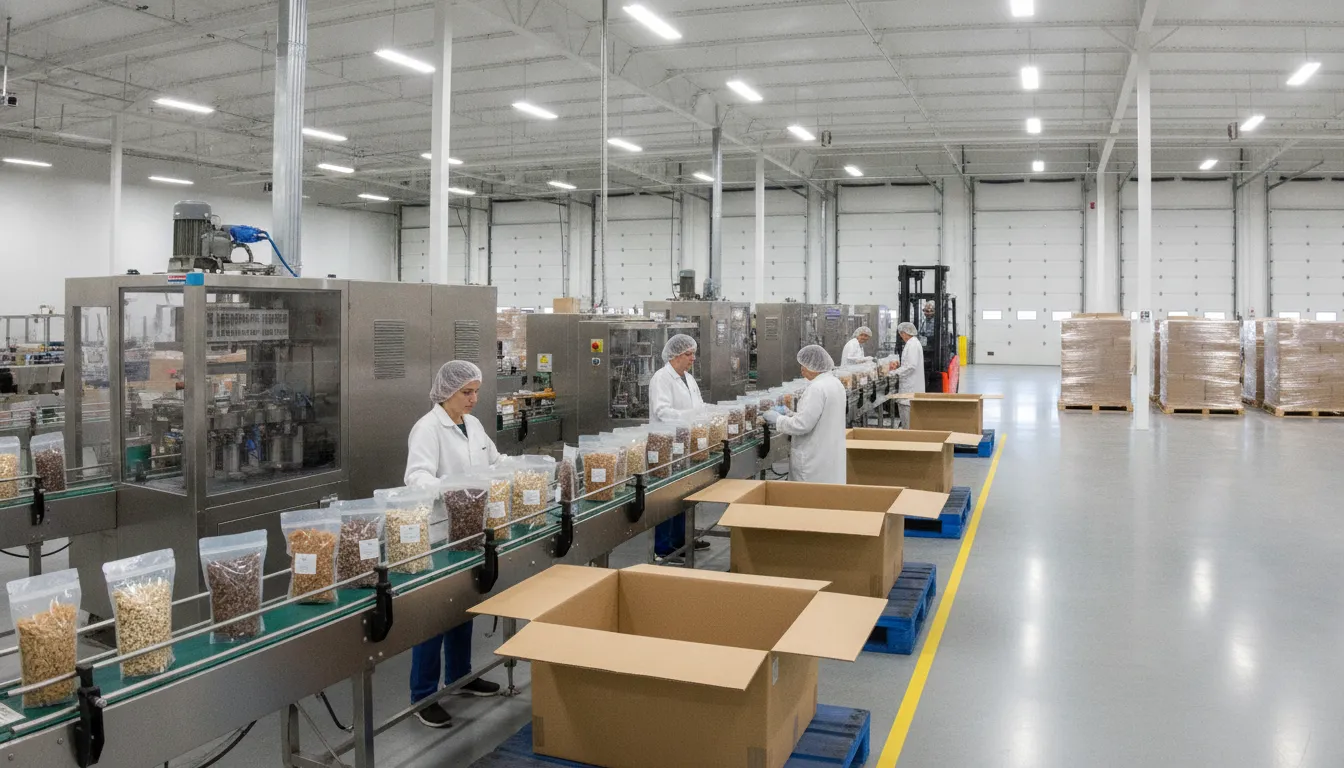
For a food brand selling on Amazon, fulfillment is part of the product experience. Inventory must be stored appropriately, orders picked and packed consistently, and shipments handed to carriers without losing visibility or control. That becomes more complex when production, warehousing, and marketplace operations sit with different partners.
Contact Co Packing Express about FBM fulfillment
Amazon FBM fulfillment for food brands means the seller manages order fulfillment through its own operation or a chosen partner, rather than sending every unit through Amazon. This model can support closer control over inventory, product handling, and shipping decisions, especially for shelf-stable liquids, spices, and powders. Co Packing Express combines production, packaging, and fulfillment support from St. Petersburg, Florida, where regional I-4 and I-75 access can support broader distribution planning. For the FBA path, see this Amazon FBA and private-label food manufacturing playbook.
The right workflow starts by defining who owns each step, from finished-product storage through order handoff and customer service. First, it helps to clarify what merchant fulfillment means for a food brand and where a co-packing partner fits.
What Does FBM Mean for Food Brands on Amazon?
FBM means Fulfilled by Merchant. Instead of sending every unit into Amazon’s fulfillment network, the seller manages order fulfillment through its own facility or a fulfillment partner. Amazon describes FBM as a model in which sellers fulfill orders from a warehouse they operate or choose. That makes FBM an operational decision about inventory, preparation, and shipping ownership, not a promise of a particular sales, ranking, or delivery result.
Who owns the work in an FBM model?
With FBM, the brand remains responsible for making sure an order is available, picked accurately, packed appropriately, and handed to a carrier within the required process. The seller also needs a clear plan for inventory counts, product condition, order data, returns, and customer-service responsibilities. A co-packer can perform some or all of the physical work, but the brand still needs documented standards and a reliable workflow for coordinating those activities.
That level of control can suit shelf-stable food brands that sell through more than one channel. A company may want finished goods available for Amazon orders, its own website, wholesale accounts, or another marketplace without separating all inventory into different programs. It can also give the brand a closer view of packaging quality, lot handling, and stock allocation. The tradeoff is that the seller must plan the fulfillment process instead of treating shipping as an automatic extension of manufacturing.
For brands researching amazon fbm fulfillment food brands, the practical question is not simply whether FBM is available. It is whether the production, storage, order handling, and customer-service responsibilities are assigned to a capable team. These decisions should be made alongside the product’s shelf life, packaging format, expected order volume, and sales-channel mix.
Co Packing Express provides production, packaging, and fulfillment support for emerging food brands from its facility in St. Petersburg, Florida. Its focus includes shelf-stable liquids, spices, and powders. The location also provides access to the I-4 and I-75 corridors for regional and national distribution planning, without implying a guaranteed delivery speed. Brands comparing manufacturing and fulfillment options can also review this Amazon FBA and private-label food manufacturing playbook before deciding how FBM fits their broader operation.
How Amazon FBM Fulfillment for Food Brands Works With a Co-Packer
Amazon FBM fulfillment for food brands works best when production, storage, order handling, and customer ownership are defined before the first order arrives. A co-packer can support the physical workflow, but the brand still needs a clear operating plan for inventory, order data, carrier decisions, returns, and customer communication. The goal is a controlled handoff, not an assumption that every function is automatically connected.
A practical production-to-customer workflow
- Confirm the product and production handoff. Start with the approved formula, packaging specifications, case configuration, labeling requirements, and the sales channels the product will serve. Co Packing Express focuses on shelf-stable liquids, spices, and powders. Its documented production capacity is up to 5,000 units per hour, but actual output depends on the product, packaging, run requirements, and agreed specifications. Define what the co-packer receives from the brand, what it produces, and what condition the finished inventory must meet before fulfillment begins.
- Move finished inventory into an agreed storage plan. After production, establish where inventory will be held, how it will be identified, and when it is available for orders. Co Packing Express offers 72 hours of free post-production storage. Climate-controlled warehousing is available at $60 per pallet per month. For spices and powders, storage conditions and handling expectations should be documented because moisture exposure can affect product quality. The brand and co-packer should also agree on lot information, counts, damaged units, and the process for reconciling inventory.
- Set the pick-and-pack rules. Create written instructions for unit selection, quantity, packaging materials, inserts, case packing, and any Amazon-specific preparation requirements. The instructions should identify which products are eligible for fulfillment and how exceptions are handled. This is also the point to distinguish individual customer orders from wholesale or other channel shipments. For a broader overview of evaluating a outsourced fulfillment and co-packing partner, review the contract packaging buyers guide.
- Define how order data is delivered. Decide what information the fulfillment team needs for each order, such as SKU, quantity, shipping address, order identifier, and requested service level. Do not assume a particular marketplace integration, automation, or software connection unless it has been tested and included in the operating agreement. A documented file, portal, or other agreed method can work when responsibilities, cutoff times, error handling, and confirmation steps are explicit.
- Coordinate the carrier handoff. Once an order is picked and packed, establish who selects the carrier, creates or supplies shipping documentation, applies the label, and records the tracking number. The co-packer may prepare an order for dispatch, while the brand may retain responsibility for carrier accounts, shipping policies, and marketplace communication. Confirm the handoff process in advance, but avoid promising a delivery speed that depends on a carrier or destination outside either party’s control.
- Assign returns and customer service ownership. FBM brands should decide who answers buyer questions, handles address corrections, investigates delivery issues, authorizes returns, and records complaints. A co-packer can help identify a lot, packing date, or fulfillment exception, but the seller generally needs a customer-facing process that matches its Amazon account responsibilities. Define when an issue is escalated to production or quality control, and keep records that connect the customer order to the relevant inventory.
Before launch, document each handoff in one operating checklist and review it with the production and fulfillment teams. That checklist should make clear what happens to inventory after production, how orders are transmitted. Where shipping responsibility changes hands, and who owns the customer relationship when an order does not go as planned.
FBM vs. FBA for Food Products: Which Model Fits?
The right fulfillment model depends on how much operational control your food brand needs and where inventory should sit. With Fulfilled by Merchant (FBM), Amazon sellers manage fulfillment through their own facility or a chosen partner. Fulfilled by Amazon (FBA) places the Amazon order-fulfillment function within Amazon’s network. Neither model is automatically the better choice for every shelf-stable product. The decision should reflect your channels, inventory workflow, customer-service responsibilities, and ability to maintain consistent product handling.
For brands evaluating co-packing for Amazon FBA, the FBA-specific production and preparation path deserves separate consideration. FBM is different because the brand retains more direct responsibility for storing sellable inventory and coordinating order shipment. That distinction can matter when the same product also serves a direct-to-consumer store, wholesale account, or another marketplace.
| Consideration | FBM | FBA |
|---|---|---|
| Control | The seller or selected fulfillment partner controls inventory handling, packing decisions, and shipment release. | Amazon manages fulfillment after inventory is received into its network, subject to its processes and requirements. |
| Storage | Inventory remains with the seller or a designated warehouse, allowing storage procedures to be planned around the product. | Inventory is stored in Amazon facilities, with inbound planning and replenishment becoming important operational tasks. |
| Shipping | The seller or partner coordinates order handling and carrier handoff for each shipment. | Amazon handles order fulfillment within the FBA program after receiving inventory. |
| Flexibility | One inventory workflow can support Amazon, DTC, wholesale, and other channels when the operation is structured accordingly. | The workflow is centered on inventory sent into Amazon’s fulfillment network and the requirements of that program. |
| Best fit | Brands that want direct oversight, multi-channel coordination, or a fulfillment partner aligned with their handling standards. | Brands that prefer to outsource Amazon order fulfillment and can plan production, preparation, and replenishment around FBA. |
FBM can be practical when control over storage and shipment preparation is part of the brand’s quality strategy. A co-packer and fulfillment partner may coordinate production, hold inventory, and prepare orders while the seller remains responsible for the Amazon account and the customer experience. This approach requires clear procedures for order data, lot tracking, inventory counts, shipping rules, and exceptions.
FBA may fit a brand that wants Amazon to handle the fulfillment portion after inventory is received. However, production planning still matters. The brand must align finished goods, packaging, preparation, replenishment, and channel demand with the FBA workflow. For a business selling across several channels. Comparing both models against the complete inventory plan is more useful than judging either option by a single fee or performance assumption.
Compliance Requirements for FBM Food Shipments
Food brands using FBM need more than an Amazon-ready shipping label. The product must remain correctly identified, traceable, safe to store, and properly documented from production through delivery. Amazon prep responsibilities and food safety responsibilities overlap, but they are not the same. Prep may address carton, barcode, packaging, or shipment requirements for a sales channel. Food safety covers the controls that protect the product itself and support consistent handling throughout the supply chain.
Build a shipment record that follows the product
Start with the label and product specification. The packaging should present the information required for the product and follow the FDA’s Food Labeling Guide. Review the finished label, ingredient statement, allergen information, net quantity, lot coding, and expiration or best-by information before the product enters fulfillment. The exact requirements can vary by product, so brands should confirm the details for their formula and packaging.
Lot and expiration traceability should connect each shipped unit to its production record. A practical record identifies the finished product, lot, production date, shelf-life information, quantity released, storage location, and shipment destination. If a question arises about a customer order, this information helps the brand determine which inventory was involved rather than treating every unit as identical.
Supplier verification is another core control. The FDA’s supply-chain guidance addresses supplier verification for human food. Keep supplier records, ingredient specifications, receiving checks, and relevant production documentation organized so the brand and its co-packing partner can confirm what entered the process.
- Confirm labels and product specifications before the first fulfillment run.
- Assign lot and expiration information that can be traced to production records.
- Document ingredient suppliers, receiving checks, and verification activities.
- Define storage conditions and protect product condition during handling and shipping.
- Keep production, release, inventory, and shipment records accessible for review.
Storage conditions deserve particular attention for shelf-stable liquids, spices, and powders. A fulfillment plan should state where inventory is held, how it is protected from unsuitable conditions, and how older or shorter-dated lots are managed. Co Packing Express describes its facility as FDA compliant and HACCP compliant, and its food quality-control standards provide a useful starting point for discussing the controls your product requires.
Finally, define ownership in writing. The brand remains responsible for accurate product information and its Amazon account obligations. The fulfillment partner should have clear instructions for inventory release, picking, packing, exceptions, and documentation. Separating Amazon prep from food safety controls prevents a shipment from appearing channel-ready while important product safeguards remain undefined.
How to Set Up FBM Fulfillment With a Co-Packing Partner
A reliable FBM arrangement starts before the first Amazon order arrives. Your co-packing partner needs a clear view of what you sell, how it must be produced and stored, and which fulfillment responsibilities remain with your team. Use the following checklist to define the relationship and reduce avoidable handoff problems.
- Confirm product scope and channel requirements. Start by documenting each SKU, product type, package format, case configuration, and intended sales channel. Co Packing Express focuses on shelf-stable liquids, spices, and powders. It does not handle meat, poultry, fish, potable alcohol, tin cans, or refrigerated and frozen products. Identify Amazon prep, labeling, lot-code, and expiration requirements as well as any DTC or wholesale orders that may share the same inventory. This scope review helps determine whether one inventory pool can support all channels.
- Share specifications and define the production target. Provide the formula, ingredient and packaging specifications, finished-unit dimensions, case pack, storage conditions, and quality requirements. Discuss acceptable production variance before issuing a purchase order. Co Packing Express uses a plus-or-minus 10% production tolerance, so your forecast and inventory plan should account for that range. If the product is still being finalized, document the test-batch or approval process separately from the full production run. For a practical planning framework, review how to scale a food product to a co-packer.
- Check minimum order quantities and commercial terms. Compare the expected order volume with the partner’s minimums. Co Packing Express requires a minimum of 100 gallons for liquids and 400 pounds for dry products. Confirm the production deposit, balance due, packaging costs, storage charges, and any fulfillment or prep fees in writing. A 75% deposit is required for production services. Aligning these terms with your demand forecast prevents an FBM program from tying up more inventory or cash than the business can support.
- Plan storage and inventory ownership. Decide where finished goods will be held, who owns the inventory at each stage, how stock levels will be reported, and what triggers a replenishment run. Co Packing Express offers 72 hours of free post-production storage, with climate-controlled warehousing available at $60 per pallet per month. Specify temperature and moisture requirements for each SKU, particularly spices and powders. The St. Petersburg, Florida facility also provides access to the I-4 and I-75 corridors for regional and national distribution planning, without assuming a guaranteed delivery time.
- Map the order, carrier, and returns workflow. Establish how new FBM orders reach the fulfillment team, what information must accompany each order, and who confirms shipment status. Do not assume a specific software integration until it has been verified. Agree on the pick-and-pack process, carrier selection, shipping-label responsibility, tracking updates, damaged-package procedures, and inventory adjustments. Your brand remains responsible for Amazon account performance and customer-service decisions unless the contract explicitly assigns a task to the partner. Define who receives returns, inspects returned food products, approves disposition, and communicates with the customer.
- Review the process before launch, then at regular intervals. Run through a sample order from purchase order to delivery exception. Verify the approved package, shipping label, lot or expiration information, inventory count, and escalation contacts. After launch, review order accuracy, stockouts, damaged shipments, returns, and production planning on an agreed schedule. This review should lead to specific changes rather than vague promises. A written operating review gives both sides a chance to adjust forecasts, storage, or carrier responsibilities as the brand grows. When you are ready to discuss product scope and fulfillment responsibilities, contact Co Packing Express.
Contact Co Packing Express to review your food brand’s FBM fulfillment requirements
Frequently Asked Questions
What does FBM mean for a food brand selling on Amazon?
FBM means Fulfilled by Merchant. Instead of sending inventory to Amazon for fulfillment, the seller manages order fulfillment through its own operation or a selected partner. That arrangement gives the brand more control over inventory handling, packaging, and shipping decisions, but the seller remains responsible for meeting its marketplace obligations.
Can a co-packer fulfill Amazon FBM orders?
Yes. A co-packer can combine production, packaging, storage, pick-and-pack, and carrier handoff when those services are part of the agreed workflow. Confirm how orders will be received, how inventory will be tracked, how returns are handled, and who owns customer service before launch. Co Packing Express supports shelf-stable liquids, spices, and powders from its St. Petersburg, Florida operation.
Is FBM or FBA better for food products?
Neither model is automatically better. FBM may fit brands that need direct control, multi-channel flexibility, or a fulfillment process built around a co-packer. FBA may fit brands that prefer Amazon-managed fulfillment for eligible inventory. Compare storage, prep, shipping coordination, service responsibilities, and the level of operational control your team can sustain.
What should I prepare before contacting a fulfillment partner?
Prepare your product specifications, packaging files, expected order volume, shipping destinations, storage requirements, lot and expiration-tracking process, and preferred order workflow. Also confirm that the product fits the partner’s scope and minimums. Co Packing Express lists minimums of 100 gallons for liquids and 400 pounds for dry products. Review labeling and food-safety requirements using the FDA Food Labeling Guide before production.
Contact us to plan your FBM fulfillment workflow
A clear plan can help align production, storage, pick-and-pack, and carrier coordination before your food brand starts shipping orders directly. If you are evaluating FBM with a Florida co-packing partner, share your product scope and fulfillment needs so the next steps are easier to define.
Contact Co Packing Express to plan production, storage, and FBM fulfillment